Conscious Living and the Limits of Paradigms
This article aims to provide some caveats and context acknowledging the inherent challenges in writing, reading, and thinking about conscious living. It also emphasizes some ideals we aspire toward in how these teachings are presented and invites readers to stay overall conscious of systems and paradigms in general.
The limits of language
This presentation of CL is constrained by the practical limitations of text and static images (though we might eventually include other media such as audio/video resources and interactive discussion/support groups).
Language cannot fully describe every aspect of life, and what language we have is subject to varying interpretations. Implications and meanings change over time and between people. We always have risk of some misunderstandings.
Acknowledging these issues, we still aspire to present CL as clearly and accessibly as we can.
CL structure as mnemonic
The structure of these CL resources is meant to aid learning and memory. Other structures could work, and each of us can explore, test, and adapt the ideas in whatever ways we find useful.
Issues with file structure
The use of files, hierarchies, and lists necessarily constrains relationships. When choosing where to put certain concepts, we can:
- choose one place or the other
- split the concept into aspects that go in each place
- link or make reference from one place to another
- repeat ideas in multiple places
We can transcend the structure by acknowledging how it could be different and that no particular structure is right (though some structures do work better than others).
Traits over types
In CL, we prefer structures and concepts that bring flexibility. Discussing ideas, people, and situations in terms of traits provides more flexibility than categorizing things into types.
Throughout CL, we can consider elements or aspects that fit notable patterns. CL avoids rigid definitions about whether something is or isn't a particular category. Instead, we can ask how much of various traits something has. We can even consider the traits of traits rather than types of traits.
Process over status
As we observe, investigate, and ponder aspects of life at all sorts of scales, we never seem to find ultimate end points to anything. In CL, we don't seek or expect things to have some core essence. We don't even emphasize thingness at all. Life is a process and dynamic. As we notice distinctions and patterns, we can use labels while still recognizing that nothing can ever be pinned down in some eternal static way.
CL is adequately agnostic
In experiencing consciousness, we really do know with utter certainty that it is real. Can we know anything else with that level of confidence? Perhaps mathematical ideas?
Most of what we "know", we really just accept because the ideas help us make falsifiable predictions that we see validated repeatedly. We tend to doubt and drop ideas that offer no predictive insights or which lead to predictions that turn out clearly false. Overall, we feel intuitive comfort with explanations and stories that seem to fit our experiences. CL includes acceptance that all this knowledge is practical and can never be ultimate or complete.
CL claims no authority
In CL, we avoid making claims that ask for deferential acceptance. Anyone can readily test the concepts for themselves.
Transcending paradigms altogether
In 1997, systems scientist Donella Meadows wrote an influential essay about Leverage Points describing 12 ways to effect change in complex systems.
One one end is the tweaking of constants, parameters, and numbers. In daily life, we might adjust how many calories we eat or how many minutes we spend meditating and so on.
The opposite end of the lever is transcending paradigms. Even beyond changing paradigms, we can free ourselves from strictly adhering to or believing any particular structures or labels.
Transcending paradigms does not mean cynically rejecting or denying anything. It means accepting that our concepts do not capture the full complexity of our experiences (let alone the rest of existence beyond what we can consciously access). A view beyond paradigms is more open and undefined, free from the limits of conceptual frames.
These conscious-living resources are themselves a sort of paradigm, a structured set of concepts and patterns that we can use (and change) to support healthy and meaningful lives. In transcending this paradigm, we acknowledge the limitations of the model and the presentation. We can understand that all such teachings are inherently fuzzy, rough, and generalized; and we can use the ideas without rigidly sticking to this or any other paradigm.
Understanding system leverage points
Meadows' Leverage Points ideas apply to all sorts of systems even though the original essay focuses on ecosystems and environmental sustainability. For the best understanding, we suggest reading the full essay thoroughly (not just skimming the headings), see https://donellameadows.org/archives/leverage-points-places-to-intervene-in-a-system. That said, the Wikipedia article has a decent summary: https://en.wikipedia.org/wiki/Twelve_leverage_points.
Widespread misunderstanding of leverage
The 12 leverage points is not a list from worst to best ways to engage with a system. The original essay does too little to avoid that misunderstanding.
As with a physical lever, different leverage points mean different ratios of amount of change to amount of effect. A point close to the fulcrum requires major effort to move, but even a small movement translates to a major effect. Farther from the fulcrum, making changes is much easier, but it requires much larger change to have any real effect.
Nearly every illustration of Meadows' leverage points totally misunderstands the metaphor and presents the list in the wrong reverse order.

The correct understanding is far more insightful and nuanced.
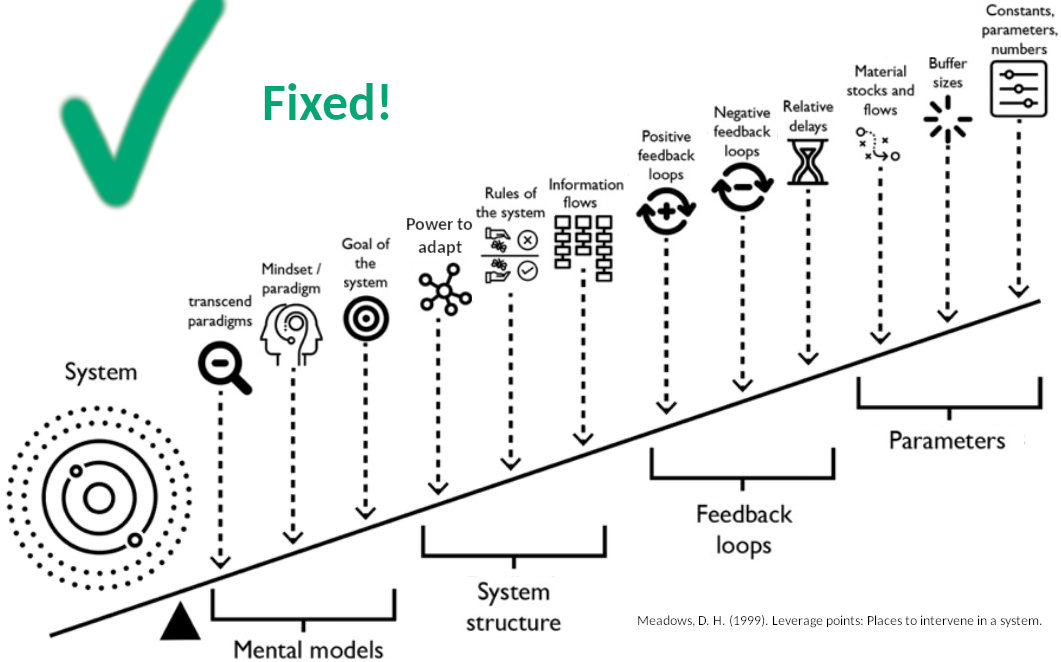
This shows us how even a tiny tweak to goals or paradigms may require a lot of effort but can make a noticeable difference. Changes to constants or buffers are much easier to make and can be just as effective if the change is large enough.
So, any leverage point can make a difference. But if we only make small changes to the easiest leverage points, very little will change. The choice of where to focus depends on the particular details and our practical capacities in each situation.
Leverage points within CL
When presenting, developing, and using CL itself, we can consider how it fits the leverage points framework. This way, we can consider where to put what level of attention and effort. The leverage points in order from easiest and weakest to most difficult and powerful:
Parameters and mechanisms
-
(12) constants, parameters, and numbers: We can consciously adjust our specific agreements such as how much time we spend on particular activities or how much of what food to eat at each meal.
-
(11) buffers: we can set up our habits and agreements to maintain buffers in our time availability and energy levels, leaving room to adapt to changing circumstances.
-
(10) flow structure: CL considers our shifting energy patterns, especially in terms of constriction and expansion, arousal and relaxation; we can intentionally set up our life to adjust the structures that influence our energy flow.
Feedbacks
-
(9) delay time, relative to rate of change: CL highlights an efficient process of attune-resolve-review that works at all scales. This pattern makes CL adaptive and able to respond quickly to emergencies while avoiding rushing other decisions. We can iterate more rapidly as we master this process.
-
(8) adjusting negative feedback loops: CL emphasizes listening to and accepting our constrictive energy which impedes and inhibits us. We can appreciate when our constrictions reduce harmful patterns and keep us safe, and we can learn to reduce overreactive constriction when it gets in the way of healthy patterns.
-
(7) adjusting positive feedback loops: CL highlights leading by example, preaching only what we practice, and continually reviewing. CL also brings awareness to expansive energy which motivates various actions. We can adjust our patterns to help reinforce healthy feedback loops and relax unhealthy ones.
System design / structure
-
(6) structure of information flows: CL supports the use of measurement tools as well as coaching, collaboration, and community practice; CL includes methods for how to live with integrity, including appropriate candor, considering when and how to reveal ourselves to others. Most importantly, CL is about improving our ability to consciously notice whatever we experience.
-
(5) rules of the system (including incentives and constraints): CL includes many practice tools to guide us in adding or removing friction and setting up overall life to support our commitments.
-
(4) the power to change and evolve: As a system, CL includes self-correcting features. CL embraces FLO (Free/Libre/Open) adaptation to support continual improvement of our life patterns and of the CL resources themselves.
Intent and framing
-
(3) changing goals: CL reframes our goals to align with healthy and ethical ways of living. CL means continually adjusting, updating, and reinforce our understandings and commitments.
-
(2) paradigm-shift: CL itself offers a transformative contrast to many common worldviews and mindsets. One of the main points in CL is exploring perspectives by actively trying different stories, styles, metaphors, and other viewpoints.
-
(1) transcending paradigms: as highlighted above, we can acknowledge that no evolution of CL structure, language, and presentation can ever make it perfect and complete. And the same applies to any potential substitute or alternative paradigm. We can let go of analyzing and structuring everything, bringing awareness to how consciousness flows as an ineffable process not bounded by any paradigm or conception.